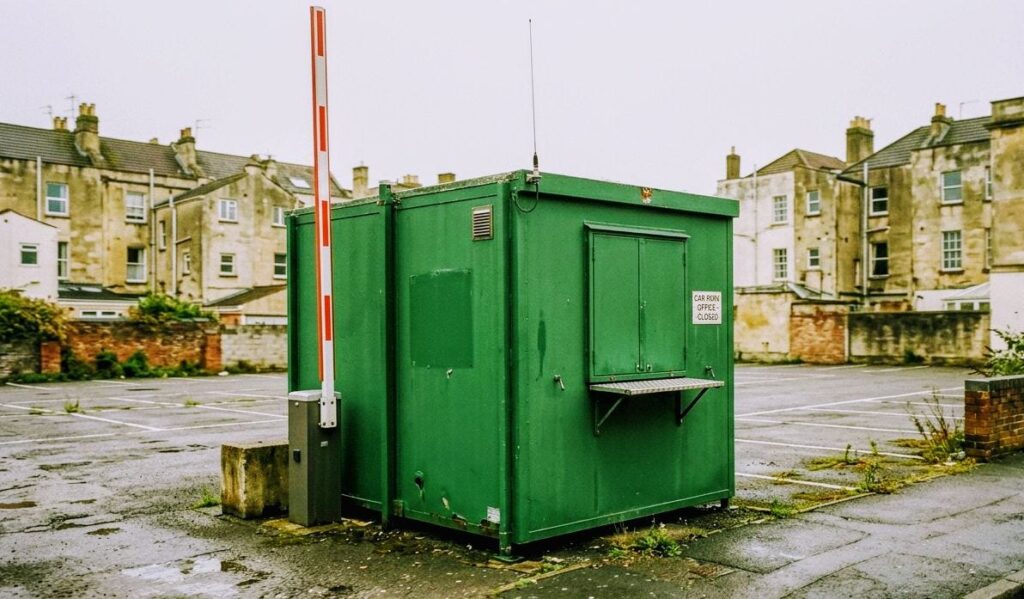
Alex Harper constructs a narrative with many fragments and symbols that the reader must assemble to uncover the truth. This creates a dense, engineered plot where almost every detail functions as a clue effectively turning the reader into a co-creator.
As a gamer, reading this story reminded me of the narrative puzzle game Mosaic. Just as the game presents you with 24 story tiles you must arrange to reveal a hidden truth, CAR PARK provides symbolic fragments (the missing attendant, a Facebook clue, an unpaid receipt, a bureaucratic letter) that the reader must mentally assemble to understand the reality beneath the surface. The reader (or player) becomes an active co‑creator of the narrative, and the satisfaction comes from that final click when everything falls into place. CAR PARK understands this completely: its mystery is not delivered but constructed.
This is a masterfully built piece of fiction. CAR PARK operates on a layered symbolic architecture that, until recently, I often wondered how authors sustained across a narrative of any length (later more about this). The thermos ring. The birdseed. The lanyard. The unpaid receipt. The planning permission notice with its eighteen‑month expiration. Every object returns, every detail earns its place. The story rewards the attentive reader without punishing the one who simply wants to know what happened to Jimmy.
[***SPOILER-ALERT] Symbolic Density
When I read the story for the first time I felt like a detective. I had the urge to find and uncover all symbols and hidden themes so that I really could talk about it without having overseen maybe the most meaningful clue or theme. Thus, I put my findings in the table below. For the readers who do not mind spoilers it is imo a good visualization of the symbolic density and its pay-off. And all this in about one hour reading time. This is super-dense!
| Symbol | Location | Meaning |
| The thermos ring | Shelf in portacabin | Presence through absence; twenty years of ritual reduced to a pale stain |
| Birdseed | Paper bag on floor | Jimmy’s invisible care; the only thing he left behind that wasn’t purely functional |
| The lanyard | J. WARNER, self-made | The contract that existed only because nobody checked it |
| FREE PARKING TODAY | Handwritten sign | The zoo’s helplessness; the vacuum left by competence |
| The hold music (light jazz) | Recurring motif | Institutional inertia; the pleasant, immovable refusal to answer |
| August / Spain / harbour | Patricia’s photographs | The destination; the reward; what Jimmy was working toward for twenty years |
| Planning permission notice | Folded in filing cabinet | “Eighteen months, pending review” — the lie that became true through repetition |
| Gerald the tortoise | Enclosure seven | A mirror for Jimmy: woken early, in a bad mood, nobody knows why |
| The unpaid receipt | COLLEGE ROAD CAR PARK | The paper trail that leads nowhere; Jimmy’s entire employment status in a single document |
| The coach bays | Back of car park | What everyone missed; the missing £468,000 |
What I Missed: Passion
For all its brilliance, the piece left me hungry for something I couldn’t quite name for a while. Was I over critical? Had I set out on a mission to find the proverbial crack in the wall just because AI was involved in authoring and there must be something wrong?
I found out what it was when I fired up the game Mosaic after so many years again. The otherwise gray game has elements of passion included—even in early gaming tiles. In the CAR PARK we learn what Jimmy did: reliable, neat, professional, fond of birds, two sugars, a good handshake. We know he took his holidays in August and went to the same Spanish bar every year. We know he endured twenty years of being unseen.
But we don’t know why.
What drove him? What got him out of bed on the grey Tuesday mornings when there was nobody to wave through? No applause. Nobody told him that he was the greatest CAR PARK guy on the planet and, in a g’ol US way, make him the CAR PARK employee of the month? How did he endure this?
The story gestures at the birds, and that’s lovely—a man feeding jackdaws from a paper bag—but it’s not enough. Dotty says “He just did it,” and that captures something essential about Jimmy, but also something frustrating. Did he love car parks? The order of them? The ritual of directing traffic? Did he love the zoo itself? Did he hate it, and the million pounds was revenge? Did he simply decide, one day, that he needed a project?
The story implies that Jimmy must have known he was a number. That awareness powers the final twist. But what did that awareness feel like? Did it grind at him? Liberate him? Did he ever stand in the portacabin and think nobody would notice if I simply stopped—and then keep going anyway? The piece is so committed to the manager’s perspective that it cannot answer these questions. I respect the craft choice, but I missed it. I wanted one crack in Jimmy’s neat, sensible, hi‑viz surface where he let himself want something other than being a nobody.
The free birds (as opposed to the ethically questionable animals in cages he supported with his work) are the closest we get. And perhaps that is the answer: Jimmy’s passion was not for cars or car parks but for free living things. The sparrows. The pigeons. The jackdaws who came back every year. The zoo manager never once saw Jimmy feed them; he only heard about it secondhand. That distance may be the point.
On AI and Achievability
What strikes me about CAR PARK is how a human author holds all of this in working memory simultaneously. The financial calculations across twenty years. The nested timelines (the zoo manager’s seven years, Charlie’s thirteen before that, Jimmy’s twenty). The callbacks to birdseed, to the thermos, to the lanyard that appears in paragraph six and pays off sixty pages later. This is the kind of structural integrity that feels almost architectural. I suspect that AI was in this case making this kind of densely symbolic, clue‑loaded storytelling more achievable for contemporary writers. Which is a good thing. Imo. A very good thing.
Not by writing the story for them, but by helping track the latticework of references, by flagging when a symbol has been dormant too long, by allowing a single human imagination to operate at a scale previously reserved for the most obsessive of plot‑board enthusiasts. Harper has used whatever tools were available to produce something that feels, in the best sense, engineered.
Final Verdict
I wanted more of Jimmy’s passion because the story made me care about him. So I was planning to give this 4.5 out of 5 stars. But since there are no half stars it is 5 out of 5: a genuine achievement. A mystery that works, a character study that earns its final image, and a meditation on invisible labour that will sit with you—especially when you live your life as a low man on the corporate totem pole/s.
Final verdict: 5/5
CAR PARK can be read on Millington Studios’ Substack.