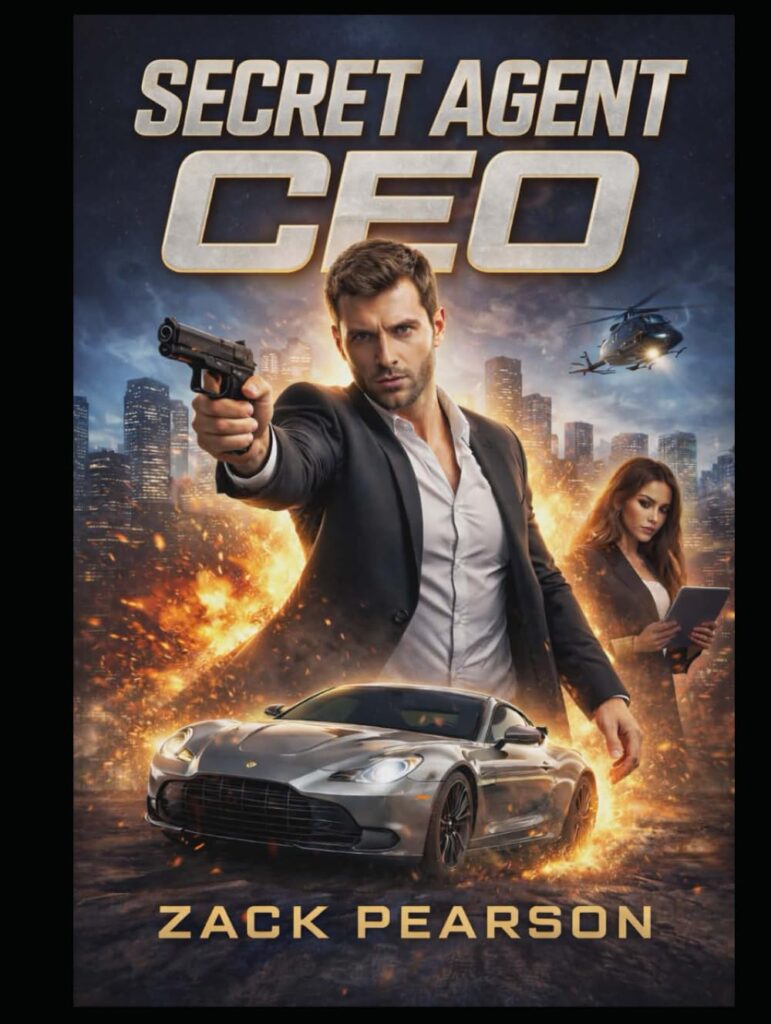
Zack Pearson strips traditional novelistic conventions down to their most functional bones: short chapters, screenplay-like dialogue, and cliffhanger pacing. As an accidental artifact of the AI-prompted, mobile-first era, he maps new territory in frictionless storytelling.
First-off: This book—if we can call it a “book” at all—violates so many best practices. It is published only as A4-sized hardcover, no table of contents, new chapters do not start on a dedicated page (the recto-page as the pros call it),; chapter titles are not printed in bold.
Chapters are very short and each of those short chapters ends with sort of a cliff-hanger that feels unearned.
The writing is efficient at moving plot and delivering dialogue, but it lacks literary depth, sensory immersion, and narrative rhythm. It’s closer to a “first-draft screenplay” than published prose fiction. The overall quality is below published fiction standard and would qualify at best as a screenplay-style outline.
But there are many more layers that I want to discuss. First let’s look at a few things that work well and a few things that don’t. Then I’ll say something about the book altogether.
What works well (for me) was the screenplay style that lacks so much narration but focuses on the punchy elements. The author doesn’t linger. This creates momentum and, to me especially the chase to save Samantha really felt well “produced”.
Information is delivered through conversation, which keeps the story moving. Lines like “Jason wasn’t working alone” and “Their first move is already in motion” are efficient plot engines.
The gadget list (shield projectors, EMP emitters, cloaking fabric) feels very real. I find that not too many authors can produce factional gadgets that are believable and are also used this way. It gives Zack Pearson credibility as an engineer.
Some nice emotional beats (in a novel where character development is otherwise absent).
The exchange between Zack and Samantha—”What do you need from me?” / “To trust me.” / “Always.”—has genuine warmth, even if it’s brief.
And then, that plot does not deceive you. You never doubt who to root for. Zack is competent and protective; Samantha is supportive without being helpless.
What did not work for me. Well, so many things.
First and foremost the already mentioned Stage-Direction Prose like in “Jason looked up, eyes filled with regret.” These are directorial notes, not novelistic prose. A novel would embed those emotions in imagery, in the atmosphere or action. Furthermore, nearly every line of dialogue or action gets its own paragraph break. This mimics a screenplay’s shot-by-shot rhythm but becomes choppy and repetitive in prose.
Absence of Character Development. I was for a moment pondering writing “Shallow Character Development”—but it is not even shallow. It is absent. No internal conflict, no contradictory impulses, no lore revealed through behavior.
While I can grasp the story, I missed locations being worked out a bit better. “Worldbuilding” authors would call it. In worldbuilding the novel also scores zero. Locations are named (“Black-Level interrogation chamber”, “Pearson Tower balcony”) but rarely felt. We don’t smell, hear, or physically experience spaces. The Supra is “sleek” and “charcoal-black”—fine, but flat.
But… Could a Case Be Made? … that this is acceptable?
We are entering an era of ‘Prompted Prose’ — narrative text generated by non-readers using AI, published directly from mobile devices, prioritizing to put their plot out there and throughput over literary quality.
This is not the novel-style we know. It is a new hybrid: screenplay-adjacent, AI-mediated, frictionless storytelling. It has its own grammar (fragmented paragraphs, dialogue-as-exposition, emotional stage directions) born from how people talk to AI — not from how people read books.”
A Post-Literate Narrative
I would like to call it “Post-Literate Narrative”. It probably works best with an audience that has never read a novel either, so they don’t miss what isn’t there.
But here’s the catch: categories require community and intentionality. If thousands of people start doing this knowingly, adopting conventions, calling it Post-Literate Narration, then a new category emerges. One person doing it by accident is not a movement.
Final verdict: 2/5
Secret Agent CEO has ISBN 979-8244702354 and is available on amazon.